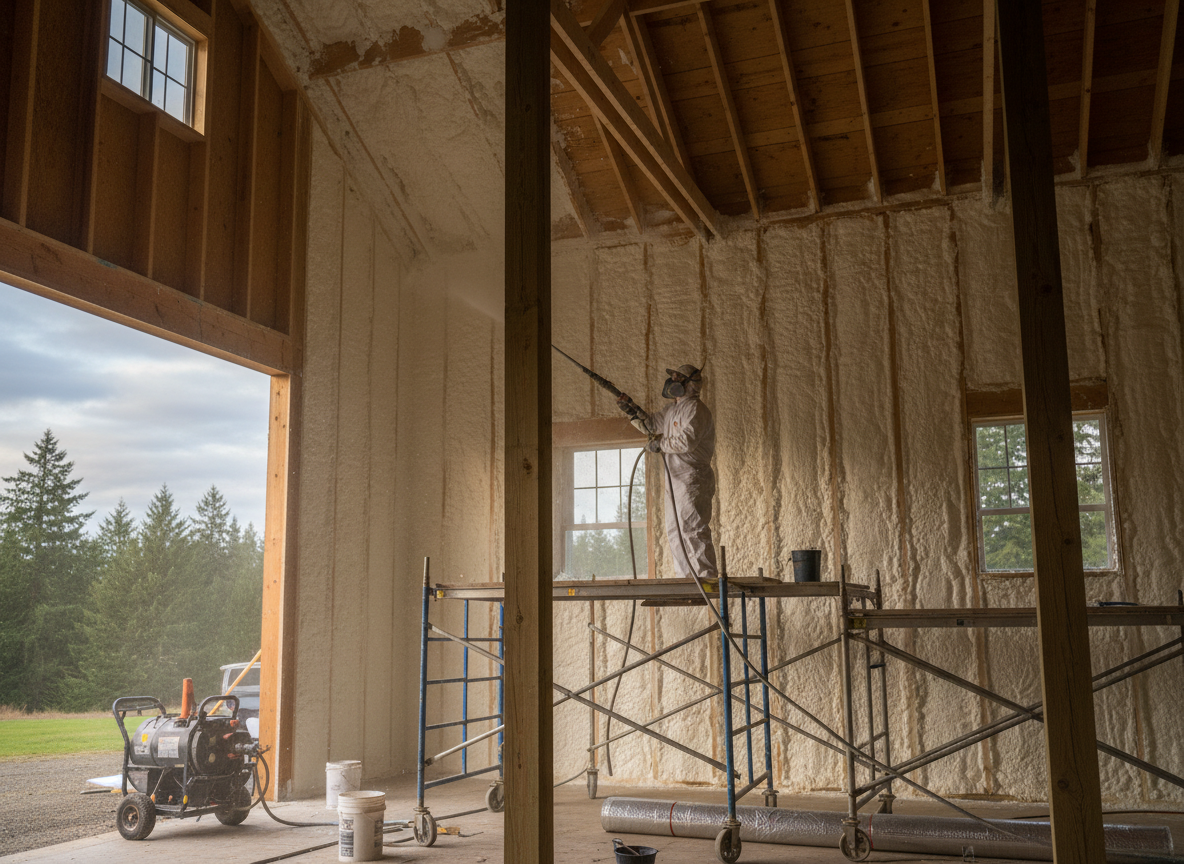
Pole barns in Milwaukie often sit exposed to the Willamette River's humidity and Clackamas County's mild wet winters that drive condensation inside unheated spaces. Closed-cell spray foam works best here because it creates an air and moisture seal around the metal skin and wooden poles without trapping water against the structure. Fiberglass batts fail quickly when roof leaks or ground moisture from Ardenwald's clay soils reach them. Proper vapor retarders on the warm side and ridge venting prevent the ice dams and mold that appear after repeated winter storms.
Many pole barns near Downtown Milwaukie and Island Station date from the 1970s and 1980s with wide post spacing and minimal original insulation. These older frames require blocking between purlins and careful sealing at every penetration to stop air leaks that Portland's dry summer winds later pull through. We always check for existing rot at the base plates before starting, especially on lots that slope toward the river. Skipping this step turns a simple insulation job into a structural repair once the new material hides the damage.
Moisture Control Details
In Clackamas County pole barns we install closed-cell foam directly to the metal and add a Class I vapor barrier on the interior face. Ridge and eave vents are added or enlarged to handle the humidity load from the Willamette during winter. All seams at poles and girts receive compatible sealant rated for continuous moisture exposure.
Common Edge Cases
Barns converted to workshops in Hector Campbell frequently have electrical runs and overhead doors that create thermal bridges. We wrap these with insulation board before foaming so the finished surface stays uniform. Ground moisture from seasonal high water tables near the river requires a sealed vapor barrier on the dirt floor before any wall work begins.
Technician insight
In Milwaukie the thing that catches most people out with pole barn insulation is ground moisture rising through the dirt floor during wet winters, especially on lots near the Willamette River in Island Station or Ardenwald. Without a sealed vapor barrier on the slab first, even good wall foam later shows condensation at the base plates.
Workshop Conversion in Hector Campbell
A pole barn used as a workshop near Hector Campbell showed persistent condensation on the metal walls each winter. We found missing ridge vents and no floor vapor barrier allowing river humidity inside. Closed-cell foam was applied after adding vents and sealing the dirt floor. The space stayed dry through the next wet season with no further moisture issues.
How it works
- 1
Site Assessment
We inspect the pole barn frame, roof condition, existing moisture, and ventilation paths while noting exposure to the Willamette River and local wind patterns.
- 2
Material Selection
Closed-cell spray foam or rigid board is chosen based on the barn's use, roof slope, and whether the space will be heated or left unconditioned through Milwaukie's wet winters.
- 3
Preparation and Sealing
Gaps at poles, girts, and base plates are blocked and sealed. Ridge and eave vents are added or enlarged to manage humidity from the surrounding Clackamas County terrain.
- 4
Installation and Finish
Insulation is applied in lifts, vapor barriers installed, and all penetrations sealed. Final inspection confirms no air leaks remain before the project is complete.
Pricing
Pricing varies by barn size, insulation type, and ventilation work required. Upfront quotes follow an on-site inspection.